Wan_2.2_ComfyUI_Repackaged Locally via LM Studio with Native FP4

Wan_2.2_ComfyUI_Repackaged Locally via LM Studio with Native FP4

The fastest method for installing this model locally is by using Docker.

Carefully read and apply the steps described below.

The system automatically triggers a cloud download for all heavy weights.

Once launched, the wizard detects your specs to configure the model for maximum efficiency.

🛡️ Checksum: 6765bc4fd4935d64b02739efa78b2b91 — ⏰ Updated on: 2026-06-30


  • Processor: high single-core performance needed for token latency
  • RAM: required: 16 GB absolute minimum for small models
  • Disk Space: 80 GB NVMe SSD required for fast model weights loading
  • GPU: high memory bandwidth GPU for next-gen local AI pipeline

The Wan_2.2_ComfyUI_Repackaged model delivers state‑of‑the‑art text‑to‑image generation with unprecedented speed and quality. Built on the ComfyUI framework, it seamlessly integrates into existing workflows, allowing artists and developers to iterate rapidly. Its architecture supports a wide range of aspect ratios and can produce images up to 4096×4096 pixels, making it ideal for both concept art and detailed illustration. A key advantage is the model’s efficient memory footprint, enabling high‑performance inference on consumer‑grade GPUs without sacrificing detail. Below is a quick comparison of its core specifications:

Parameter Value
Model Type Text‑to‑Image
Parameter Count 2.5 B
Max Resolution 4096×4096
Framework ComfyUI

Users have reported impressive results in both speed and visual fidelity, cementing its position as a go‑to tool for modern creative pipelines.

  1. Script automating model file splitting for FAT32 external drives
  2. Setup Wan_2.2_ComfyUI_Repackaged Locally via Ollama 2 Full Speed NPU Mode FREE
  3. Installer configuring localized autogen multi-agent spaces with internal model nodes
  4. Quick Run Wan_2.2_ComfyUI_Repackaged Offline on PC
  5. Script downloading IP-Adapter-FaceID models for local consistent character creation
  6. How to Deploy Wan_2.2_ComfyUI_Repackaged Using Pinokio No Python Required Easy Build Windows
  7. Patch tuning Mistral-Large-Instruct parameters for disconnected multi-user systems
  8. Wan_2.2_ComfyUI_Repackaged Step-by-Step FREE

Leave a Reply

Shopping Cart0

Cart

Shopping Cart0

Cart

Strap Length Guide

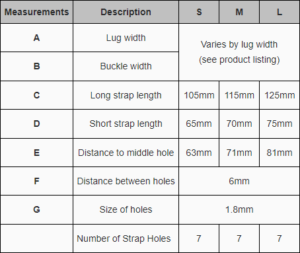
There are two sides per strap, which we refer to as the long end and the short end, which are represented by C and D respectively in the diagram below.

Our handcrafted leather straps come in 3 different lengths.

  1. Small (C: 115mm, D: 65mm)
  2. Medium (C: 125mm, D: 75mm)
  3. Large (C: 135mm, D: 85mm)

A quick way to decide on the length to get is based on your wrist size. Here is the general recommendation (if you are between sizes, we recommend to size up):

  • Wrist size of 14.5cm – 17.0cm: Small
  • Wrist size of 16.5cm – 19.0cm : Medium
  • Wrist size of 18.5cm – 21.0cm: Large

If you need a strap that is shorter than Small (115/65), or longer than Large (135/85), you can always have the strap custom made.

Size Chart


Hope this quick guide helps! Finding the perfect length to get can be a little bit more complicated, as it also depends on the lug-to-lug distance of your watch, and even the shape of your wrist. 

Find Your Lug Width

If you’re looking to purchase a strap for your watch, you will need to know the lug width of your watch. Lug width refers to “A” in this schematic below.

There are two ways to find out the lug width of your watch.

  1. Firstly, you can Google “<watch brand and model> lug width” and see if there is an answer from the brand’s website, or some other websites.
  2. Alternatively, you can simply take a ruler and measure the lug width directly on your watch.

Lug widths are typically in whole numbers, and while the most common lug widths are between 18-22mm, they can go down to 8mm or up to 32mm even. Our ready stock straps are available in 16mm, 17mm, 18mm, 19mm, 20mm, 21mm, 22mm, 24mm and 26mm. If you need other lug widths, you can have it custom made.


You will then need to purchase a strap of the same lug width. For example, if your watch has a lug width of 20mm, you will need to purchase strap with a width of 20-16.


Note: Our Widths typically have two numbers, for example 20-16. The first number (20) refers to the lug width (“A” in the schematic above). The second number (16) refers to the buckle width (“B” in the schematic above). You just need to ensure that the first number matches the lug width of your watch.