[Quick FIX] metamask-extension I-edit ang network


#RC#

Navigating the Web3 space involves managing various dependencies, from RPC providers to wallet APIs. If you see a “provider error” in metamask-extension, try switching your connection to a faster relay. A proven solution involves resetting the account nonce to match the latest on-chain data. Sometimes the transaction is dropped by the mempool because the gas price was too low.

  • The use of AI changes the risk profile compared with classical automated market makers.
  • For very large holdings, distribute risk across multiple devices or use multisignature arrangements combining KeepKey with other hardware wallets or co-signers.
  • Wallet metadata, exchange interactions, and public on-chain records can reduce anonymity.
  • Paribu’s liquidity profile reflects the characteristics of a regional exchange serving a predominantly local retail and SME trading population.
  • From a market design perspective, exchanges can mitigate liquidity constraints by incentivizing dedicated market makers, offering rebate schemes, and facilitating OTC pipelines for large trades.
  • Conversely, projects that retain unilateral minting rights or use upgradeable proxies without clear governance invite regulatory and exchange scrutiny.

Debugging metamask-extension errors is much easier if you look at the raw JSON-RPC response. The development team is focused on making the user experience as frictionless as possible. An outdated node connection is often the hidden culprit behind many transaction failures. Ensure your system time is accurate, as even a small drift can cause signature errors.

metamask-extension fix

A mismatch between the dApp’s frontend and the backend contract can cause a total halt.

Leave a Reply

Shopping Cart0

Cart

Shopping Cart0

Cart

Strap Length Guide

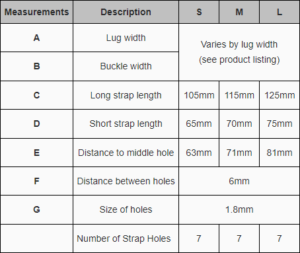
There are two sides per strap, which we refer to as the long end and the short end, which are represented by C and D respectively in the diagram below.

Our handcrafted leather straps come in 3 different lengths.

  1. Small (C: 115mm, D: 65mm)
  2. Medium (C: 125mm, D: 75mm)
  3. Large (C: 135mm, D: 85mm)

A quick way to decide on the length to get is based on your wrist size. Here is the general recommendation (if you are between sizes, we recommend to size up):

  • Wrist size of 14.5cm – 17.0cm: Small
  • Wrist size of 16.5cm – 19.0cm : Medium
  • Wrist size of 18.5cm – 21.0cm: Large

If you need a strap that is shorter than Small (115/65), or longer than Large (135/85), you can always have the strap custom made.

Size Chart


Hope this quick guide helps! Finding the perfect length to get can be a little bit more complicated, as it also depends on the lug-to-lug distance of your watch, and even the shape of your wrist. 

Find Your Lug Width

If you’re looking to purchase a strap for your watch, you will need to know the lug width of your watch. Lug width refers to “A” in this schematic below.

There are two ways to find out the lug width of your watch.

  1. Firstly, you can Google “<watch brand and model> lug width” and see if there is an answer from the brand’s website, or some other websites.
  2. Alternatively, you can simply take a ruler and measure the lug width directly on your watch.

Lug widths are typically in whole numbers, and while the most common lug widths are between 18-22mm, they can go down to 8mm or up to 32mm even. Our ready stock straps are available in 16mm, 17mm, 18mm, 19mm, 20mm, 21mm, 22mm, 24mm and 26mm. If you need other lug widths, you can have it custom made.


You will then need to purchase a strap of the same lug width. For example, if your watch has a lug width of 20mm, you will need to purchase strap with a width of 20-16.


Note: Our Widths typically have two numbers, for example 20-16. The first number (20) refers to the lug width (“A” in the schematic above). The second number (16) refers to the buckle width (“B” in the schematic above). You just need to ensure that the first number matches the lug width of your watch.