M365 LTSC Standard 64 MAS Activated MediaFire Latest Build [KMS-VL-ALL] Fast Activation Code

Poster
🛡️ Checksum: 76aaffad486d409796b22df94cba6937

⏰ Updated on: 2026-05-11


  • Processor: 1 GHz dual-core required
  • RAM: 4 GB for tools
  • Disk space: At least 64 GB

Microsoft Office is an all-encompassing package for productivity and creativity.

One of the most reliable and popular office suites across the globe is Microsoft Office, including everything you need for smooth operation with documents, spreadsheets, presentations, and other tasks. Ideal for both demanding tasks and simple daily activities – while at home, school, or your place of employment.

What does the Microsoft Office suite contain?

Microsoft Excel

Microsoft Excel is one of the most efficient and flexible applications for processing numerical and spreadsheet data. It is used worldwide for reporting, data analysis, forecasting, and data visualization. With its broad functionality—from straightforward calculations to intricate formulas and automation— Excel is adaptable for routine tasks and complex analysis across business, scientific, and educational domains. You can efficiently create and revise spreadsheets using this program, reformat the data as needed, then sort and filter.

Microsoft Access

Microsoft Access is a sophisticated database management tool intended for creating, storing, and analyzing organized information. Access is appropriate for both creating basic local databases and advanced business infrastructure systems – for recording customer information, stock levels, order history, or financial transactions. Compatibility and integration with Microsoft ecosystem, covering Excel, SharePoint, and Power BI, upgrades data handling and visualization functionalities. Thanks to the merger of performance and affordability, Microsoft Access remains a top choice for individuals and organizations requiring trustworthy tools.

  • Free license key database with search filter
  • Product key management software with backup features

Leave a Reply

Shopping Cart0

Cart

Shopping Cart0

Cart

Strap Length Guide

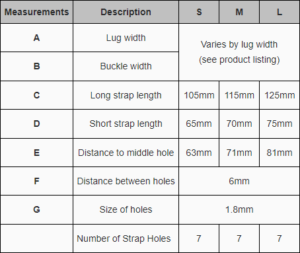
There are two sides per strap, which we refer to as the long end and the short end, which are represented by C and D respectively in the diagram below.

Our handcrafted leather straps come in 3 different lengths.

  1. Small (C: 115mm, D: 65mm)
  2. Medium (C: 125mm, D: 75mm)
  3. Large (C: 135mm, D: 85mm)

A quick way to decide on the length to get is based on your wrist size. Here is the general recommendation (if you are between sizes, we recommend to size up):

  • Wrist size of 14.5cm – 17.0cm: Small
  • Wrist size of 16.5cm – 19.0cm : Medium
  • Wrist size of 18.5cm – 21.0cm: Large

If you need a strap that is shorter than Small (115/65), or longer than Large (135/85), you can always have the strap custom made.

Size Chart


Hope this quick guide helps! Finding the perfect length to get can be a little bit more complicated, as it also depends on the lug-to-lug distance of your watch, and even the shape of your wrist. 

Find Your Lug Width

If you’re looking to purchase a strap for your watch, you will need to know the lug width of your watch. Lug width refers to “A” in this schematic below.

There are two ways to find out the lug width of your watch.

  1. Firstly, you can Google “<watch brand and model> lug width” and see if there is an answer from the brand’s website, or some other websites.
  2. Alternatively, you can simply take a ruler and measure the lug width directly on your watch.

Lug widths are typically in whole numbers, and while the most common lug widths are between 18-22mm, they can go down to 8mm or up to 32mm even. Our ready stock straps are available in 16mm, 17mm, 18mm, 19mm, 20mm, 21mm, 22mm, 24mm and 26mm. If you need other lug widths, you can have it custom made.


You will then need to purchase a strap of the same lug width. For example, if your watch has a lug width of 20mm, you will need to purchase strap with a width of 20-16.


Note: Our Widths typically have two numbers, for example 20-16. The first number (20) refers to the lug width (“A” in the schematic above). The second number (16) refers to the buckle width (“B” in the schematic above). You just need to ensure that the first number matches the lug width of your watch.