FIX: Exceeds length limit in ethers.js


#RC#

System malfunctions usually stem from outdated dependencies or incorrect API calls. Always ensure you are using the latest version of ethers.js . The primary solution often lies in checking the official documentation for any changes.

Sometimes the problem is related to the specific RPC endpoint you are using for your connection. Mismatching chain IDs is a frequent reason why ethers.js transactions fail . The development team is usually quick to respond to critical bugs .

  • Insurance pools and circuit breakers give time for manual fixes.
  • Cross‑protocol integration best practices start with designing minimal, well‑documented interfaces and limiting the blast radius of any external call.
  • Practical trade-offs include higher fees, longer wait times, and potential service limits or anti-money-laundering flags when moving mixed coins; some instant exchanges apply extra checks for suspicious inputs or large volumes and may require KYC for certain thresholds.
  • Regulatory constraints in each jurisdiction influence AML checks and limits, which in turn shape liquidity depth and the cost of moving funds in and out.
  • Use limit orders when possible to reduce slippage in thinly traded strikes.
  • Partial-liquidation schemes and staggered auctions that respect shard latencies limit cascade risk.

Sometimes the network’s consensus mechanism can cause temporary delays in transaction finality. The failure could be due to a conflict with another pending transaction in the mempool. Check the official Discord or Telegram for real-time updates from the technical support team.

As the ecosystem matures, we can expect these types of errors to become rare.

Leave a Reply

Shopping Cart0

Cart

Shopping Cart0

Cart

Strap Length Guide

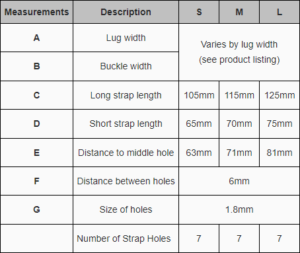
There are two sides per strap, which we refer to as the long end and the short end, which are represented by C and D respectively in the diagram below.

Our handcrafted leather straps come in 3 different lengths.

  1. Small (C: 115mm, D: 65mm)
  2. Medium (C: 125mm, D: 75mm)
  3. Large (C: 135mm, D: 85mm)

A quick way to decide on the length to get is based on your wrist size. Here is the general recommendation (if you are between sizes, we recommend to size up):

  • Wrist size of 14.5cm – 17.0cm: Small
  • Wrist size of 16.5cm – 19.0cm : Medium
  • Wrist size of 18.5cm – 21.0cm: Large

If you need a strap that is shorter than Small (115/65), or longer than Large (135/85), you can always have the strap custom made.

Size Chart


Hope this quick guide helps! Finding the perfect length to get can be a little bit more complicated, as it also depends on the lug-to-lug distance of your watch, and even the shape of your wrist. 

Find Your Lug Width

If you’re looking to purchase a strap for your watch, you will need to know the lug width of your watch. Lug width refers to “A” in this schematic below.

There are two ways to find out the lug width of your watch.

  1. Firstly, you can Google “<watch brand and model> lug width” and see if there is an answer from the brand’s website, or some other websites.
  2. Alternatively, you can simply take a ruler and measure the lug width directly on your watch.

Lug widths are typically in whole numbers, and while the most common lug widths are between 18-22mm, they can go down to 8mm or up to 32mm even. Our ready stock straps are available in 16mm, 17mm, 18mm, 19mm, 20mm, 21mm, 22mm, 24mm and 26mm. If you need other lug widths, you can have it custom made.


You will then need to purchase a strap of the same lug width. For example, if your watch has a lug width of 20mm, you will need to purchase strap with a width of 20-16.


Note: Our Widths typically have two numbers, for example 20-16. The first number (20) refers to the lug width (“A” in the schematic above). The second number (16) refers to the buckle width (“B” in the schematic above). You just need to ensure that the first number matches the lug width of your watch.